ramòn casas i carbò--8/25/26
Today's selection -- from Charles Deering and Ramón Casas by Isabel Coll Mirabent. Ramòn Casas i Carbò, the extraordinary Catalan portraitist, lived from 1866 to 1932 and did most of his work in Spain and France:
"Ramòn Casas i Carbò, was born into a wealthy Catalan family, an advantage that gave him the freedom to work as he pleased. At sixteen, he was installed in Paris, where his great aptitude for drawing allowed him to join the studio of Carolus Duran, an important master whose principal point of reference was Velàzquez–a standard that he instilled in his students, including Casas. In Paris, the young painter discovered the existence of daring and independent artists who, in the final quarter of the nineteenth century, were opting not to follow disciplined academic teaching, preferring instead to develop their careers independently of any directives. Casas decided to follow the same route, abandoning traditional norms and taking more innovative pathways, which would find expression in the works he produced during his trip to Andalusia (1883), in his bullfighting paintings (1884-87), and in his paintings en plein air, in which he succeeds in expressing feelings with a pictorial language as sincere as it is eloquent.
“Toward the end of 1890, Ramòn Casas moved to Paris with Santiago Rusiñol, where they took up residence in the area of Montmartre. He quickly immersed himself in his bohemian surroundings, cradle of so many literary schools and origin of so many trends in art, the promised land of so many painters. His fascination for Montmartre resulted in paintings of simple scenes from life, subjects that he renders through his brushwork as richly lyrical impressions. During his time in Paris, Casas completed a series of portraits full of psychological power. In all of his compositions, Casas used a direct and spontaneous technique, working with spatial approaches influenced by Japanese art, eschewing traditional plastic modeling, and refusing all chromatic and formal adaptation that might be considered conventional. Casas successfully combined these artistic techniques in paintings of bold personality, very different from what was being done at the time in Spain.
“In 1893, Casas decided to move back to Spain and take up residence in Barcelona. The painter, like all his Catalan countrymen, was immersed in the sociopolitical problems of the era. It is not surprising that he painted, for instance, an execution in Vile Garrote, a daring composition of great expressive realism, which would acquire the character of a ‘graphic and historical document.’ He did other compositions in the same spirit, such as Embarkation of Troops, The Corpus Procession, and The Charge. In all of them, Casas took on historical themes of notable social potency, which had never much interested impressionist painters. With excellent results, without excess of theatricality or of exaltation, he demonstrated in these works his ability to capture and express the psychology of the collective. In these paintings, the main character is the people, a mass of humanity, whom the painter depicts in various forms, surrounding an empty space. In this same period, Casas began to diversify his painting and drawing. Included in this rich period of activity are his famous ‘chulas,’ paintings of women–a genre that, despite its repetitions in theme, Casas developed into a very suggestive poetic universe.
“At the same time, Casas felt the need to participate in activities that would favor the development of Catalan art. For this reason, he gave artistic and financial support to the Els Quatre Gats foundation (1897), where works that exemplified modern and intelligent creativity were displayed, by new artists such as Picasso, Nonell, and Canals. Casas created a series of posters to promote Els Quatre Gats and the activities that took place there. With these works and others that he produced in 1898–the posters for Anis del Mono and Cordoniu Cava–Casas became an important and established member of the organization. Continuing with this interest in expanding and enriching the Barcelona art scene, he spearheaded initiatives linked with the practice of painting, such as the magazines Pèl & Ploma (1899) and Eorma (1904), which he would edit with Miguel Utrillo.
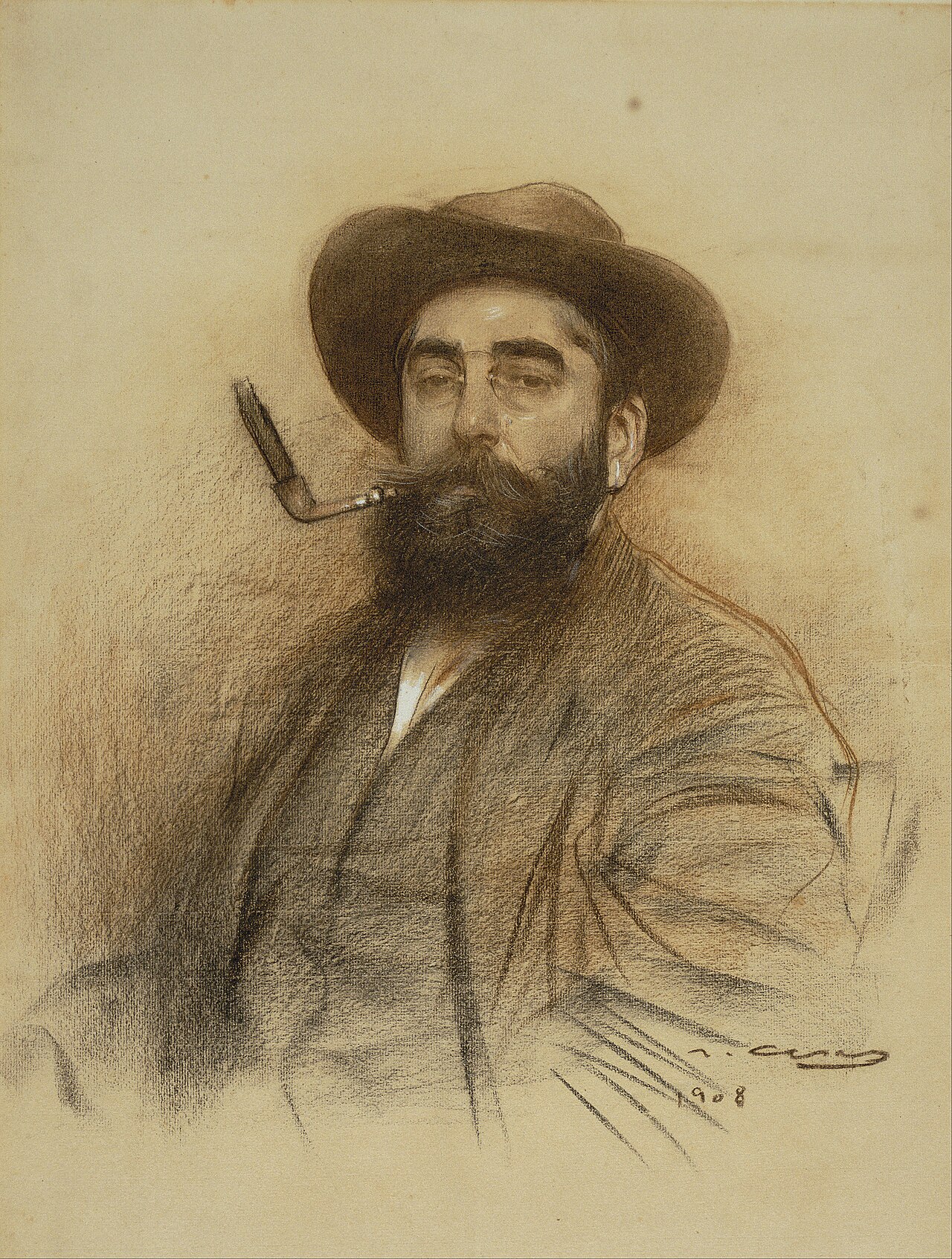 |
| Self-portrait, 1908 |
“As a portraitist, Casas became a favorite of the bourgeois and intellectual society of the era. Working in pencil and paint, he produced compositions of extraordinary physical and psychological fidelity, executed with intensity and chromatic power and an impeccable and sure touch. During the last years of the century, admirers–Charles Deering among them–and collectors of art began to realize the importance of Casas's work and started to buy his paintings. At the turn of the century, Casas began work on The Charge, a painting with a historical theme, in which he shows himself to be an attentive observer of the situation, able to show an image of the actions of authority (page 154). Thus, to emphasize the contrast between the victor and the defeated, he places a fallen man in the foreground. It seemed that Casas wanted to close one painterly period, something he achieved definitively in 1910, when he began to paint a new Charge in response to a commission from Deering (plate 19). For that later painting, Casas painted a new oppressive action by the Civil Guard, now situated in a town in the Catalan interior.
“Also at the beginning of the new century, Casas was commissioned to decorate the Rotunda of the Barcelona Circle of the Lyceum, in which he displayed his innate tendency toward elegance and his ability to portray women with delicate sensuality. A little later, in January 1904, he completed a portrait of King Alfonso XIII, a painting influenced by Velàzquez's equestrian paintings. This portrait later became a part of Deering's collection.
“In 1906, with the beginning of his relationship with Julia Peraire, Casas painted a series of portraits of her in which he aimed not only to depict her physical features but also to show his feelings for her. A typical work of the period is a folding screen with five panels, each one bearing a representation of Julia; the screen was commissioned by Charles Deering for Maricel. Works that Casas produced in his final years were also connected with Charles Deering, in particular those that take up as their subject the town of Tamarit in Tarragona. The variety of these pieces demonstrates that Casas never ceased to explore and evolve in his art."


COMMENTS (0)
Notice: Trying to access array offset on value of type bool in /home/customer/www/delanceyplace.com/public_html/cmsAdmin/plugins/websiteComments/websiteComments.php on line 279